
Operational Discipline & Customer Loyalty
In the grocery industry, we talk endlessly about "customer experience." We invest millions in branding, high-end layouts, and local sourcing. Yet, according to the American Consumer Satisfaction Index, this has produced no change in overall shopper satisfaction.
As it turns out, grocers are currently struggling with the most basic element of their business: store operations.
When it comes to store operations, one negative experience erases 100 good ones. It isn’t impacted by the glossy investments made in recent years. It's the sum total of thousands of tiny, unglamorous moments. Cleaning, maintenance, pest control, temperature checks. When those moments fail, the brand falters.
Your job isn't to make the highs higher, but to eliminate the lows in store operations. This discipline is a customer retention strategy, not just a compliance chore.
The Tyranny of the Clipboard
For decades, the grocery industry has been held together by "the way we’ve always done it." We’ve relied on binders, whiteboards, and clipboards.
But as grocery staff turnover rates hit 69%, that reliance on institutional memory has become a liability. When your store’s standards live in a binder that no one reads, they don’t actually exist. They are just a suggestion. Analog documentation creates a hidden cost of missed tasks, procedural guesswork, and lagging reports. This stacks invisible risks that management only discovers when a complaint arrives.
We are essentially asking our teams to run complex, multi-million dollar hubs of food safety and logistics using the same tools we used in the 1970s.
The Factory in the Backroom
If you look at grocery suppliers, you see a different world. In a food and beverage manufacturing plant, there is no gut feel. There is only data, process, and precision. You know a Snickers bar will taste exactly the same every time because the operation is governed by digital guardrails.
Why should a grocery store be any different?
This is why the modern store playbook is rapidly evolving. Grocers are now operating with the precision of a factory but the heart of a community hub. By moving from paper to digital playbooks, we aren't just "digitizing forms." We are creating a nervous system for the store.
From Autopsy to Real-Time Intelligence
Clipboards and binders give grocers an autopsy. You look at a report at the end of the month to see what went wrong three weeks ago. That is reactive management.
The shift to real-time store performance changes the fundamental nature of the job. With the modern store playbook, intuitive digital solutions are turning the frontlines from a place of guesswork to a place of verified execution:
-
Automated reminders ensure timeliness
-
Real-time instructions ensure consistency
-
Live translation ensures comprehension
-
Automated rules ensure completion
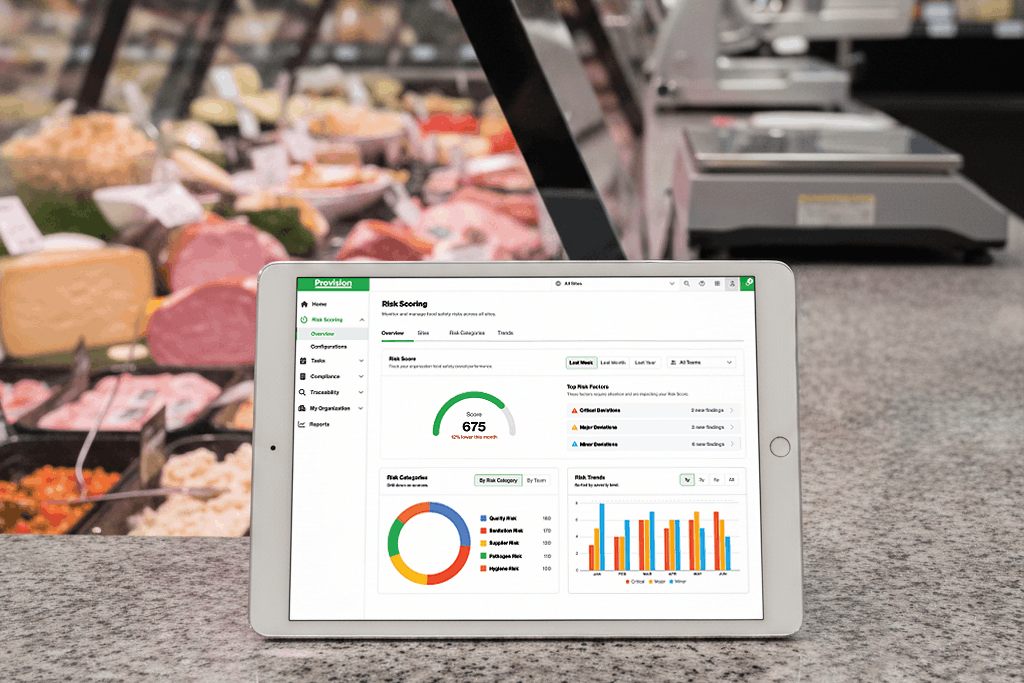
But the data doesn’t accumulate in binders. It turns into a living, breathing map of store health. Provision Risk Scoring is a breakthrough model that measures an operation’s real-time likelihood of non-conformance. It translates high-volume records into management clarity, creating a shared language that guides action from the deli floor to the boardroom:
-
Continuous tracking answers the question "Are we getting better or worse?"
-
Location benchmarking answers the question of "Which store needs help?"
-
Category trending answers the question of "Which department is at risk?"
Provision Risk Scoring combines leading indicators (like missed or late activities) with lagging indicators (such as out-of-spec results). Each indicator is automatically weighted by its criticality and prevalence, producing a holistic view that reflects real store performance.
The system is configurable, allowing grocers to emphasize the elements most relevant to their store operations. Once set, it runs continuously, turning frontline observations into forward-looking insight that helps managers stay ahead of customer satisfaction.
The Modern Store Playbook
The winners in the next decade of retail won't just have the best products. They will have the best systems.
By unifying compliance, safety, and merchandising into a single, digital playbook, we can finally close the execution gap. We can ensure that every department, in every store, lives up to the promise made on the front door.
Excellence shouldn't be an accident. It should be the default.
